Thursday, October 19, 2017

AP, AR, GL, INV, PA, FA, PO, TCA, Workflow - Interface and Base table in Oracle Apps R12

Main Interface and Base table in Oracle Apps R12


GL Module (General Ledger Module tables in Oracle Apps R12)
Interface Table
Base Table
gl_interface
gl_budget_interface
gl_je_batches
gl_je_headers
gl_je_lines
gl_je_sources
gl_je_categories
gl_sets_of_books
gl_daily_rates
gl_balances
gl_periods
gl_period_sets
gl_code_conbinations
AR Module (Account Receivable Module tables in Oracle Apps R12)
Interface Table
Base Table
ra_customers_interface_all  
ra_contact_phones_int_all
ra_customer_profiles_int_all
hz_parties hz_cust_accounts
hz_cust_acct_sites_all
hz_cust_sit_use_all
hz_party_sites
hz_locations
hz_party_site_uses
hz_customer_profiles
hz_organization_profiles
hz_person_profiles

ra_interface_lines_all
ra_interface_distributions_all
ra_interface_salescredits_all
ra_customer_trx_all
ra_customer_trx_lines_all
ra_cust_trx_line_gl_dist_all
ra_cust_trx_types_all
ar_payment_schedules_all
ra_batch_sources_All
ar_vat_tax_all
ra_terms ar_periods
ar_period_types
OM Module (Order Management Module tables in Oracle Apps R12)
Interface Table
Base Table
oe_headers_iface_all
oe_lines_iface_all
oe_actions_iface_all
oe_order_headers_all
oe_order_lines_all
oe_order_sources
oe_transaction_types_tl
oe_transaction_types_all
INV Module (Inventory Module tables in Oracle Apps R12)
Interface Table
Base Table
mtl_system_items_interface
mtl_item_categories_interface
mtl_item_revisions_interface
mtl_interface_errors
mtl_system_items_b
mtl_system_items_tl
mtl_item_locations
mtl_item_categories
mtl_item_revisions_b
mtl_parameters
hr_all_organizations_units
cst_item_costs
qp_list_headers
jft_rs_salesreps
Workflow Tables tables in Oracle Apps R12
Interface Table
Base Table

wf_items
wf_process_activities
wf_item_activity_statuses
wf_item_types_tl
PO Module (Purchase Order tables in Oracle Apps R12)
Interface Table
Base Table
PO REQUISITIONS
po_requistitions_interface_all
po_req_dist_interface_all

PURCHASE ORDERS
po_headers_interface
po_lines_interface
po_distributions_interface


PO VENDORS
po_vendors
po_vendor_sites_all
po_vendor_contacts

PO REQUISITIONS
po_requisition_headers_all
po_requisition_lines_all
po_req_distributions_all


PURCHASE ORDERS
po_headers_all
po_lines_all
po_line_locations_all
po_distributions_all
AP Module (Account Payables tables in Oracle Apps R12)
Interface Table
Base Table
ap_invoices_interface
ap_invoice_lines_interface
ap_invoices_all
ap_invoice_distributions_all
ap_payments_schedules_all
FA Module (Fixed Asset tables in Oracle Apps R12)
Interface Table
Base Table
fa_inv_interface
fa_production_interface
fa_mass_additions
fa_additions_b
fa_additions_tl
fa_books
fa_deprn_summary
fa_deprn_details
fa_deprn_history
fa_retirements
PA  Module (Project Accounting in Oracle Apps R12)
Interface Table
Base Table

pa_tasks
pa_expenditure_items_all
pa_expenditures_all
pa_transaction_constrols
pa_projects_all
pa_budget_versions
pa_resource_assigments
TCA Architecture (Trading Community Architecture tables in Oracle Apps R12)
Interface Table
Base Table

hz_parties hz_cust_accounts
hz_cust_acct_sites_all
hz_cust_sit_use_all
hz_party_sites
hz_locations
hz_party_site_uses
hz_customer_profiles
hz_organization_profiles
hz_person_profiles


“A GUIDE FOR ORACLE E-BUSINESS SUITE” –A complete Solution and Learning platform For Oracle Apps R12/11i, Training, India Localization, Technical, P2P, O2C, Drop-shipment, AR/AP Cycle, Implementation, Bug or error in Oracle Apps R12/11i, Up-gradation, Support, Alert, Personalization, Discoverer management, OracleApps R12/11i Module, Finance, SCM, MRP, ASCP, WIP, BOM, FA, AP, AR, OM, INV, AOL, MOAC, TCA structure, Project Accounting, CM, Functional,Oracle DBA, ERP, Techno-functional, OAF, Oracle Apps Interview Question and Error in Oracle apps R12/11i. For More Information Visit on www.OracleAppsGuide.com Or Subscribe your email-id on OracleAppsGuide

Order to Cash - Technical Flow in R12


 1. Order Entry
Step 1  Enter header detail, Once after entering the header details on the order header tab , click on the save button or move to lines tab. The order header gets saved and a record will insert into OE_ORDER_HEADERS_ALL with FLOW_STATUS_CODE as ENTERED , OPEN_FLAG as Y and BOOKED_FLAG as N . Header is the primary key in OE_ORDER_HEADERS_ALL
·         In the Lines tab of the order Enter item name / number, quantity and other details in line tab. Click on the Save button. After saving the line, the line data get inserts into OE_ORDER_LINES_ALL  withFLOW_STATUS_CODE = ENTERED, BOOKED_FLAG = N, OPEN_FLAG = Y  and also records will be inserted into OE_SETS with ship set details of the order.
         Primary key is the LINE_ID in OE_ORDER_LINES_ALL and the HEADER_ID is the join between OE_ORDER_HEADERS_ALL and OE_ORDER_LINES_ALL.
        SHIP_SET_ID is the join between OE_ORDER_LINES_ALL(SHIP_SET_ID) and OE_SETS(SET_ID).
     SET_ID is the primary column in OE_SETS.

2.Order Booking

Step 2 , when Order is booked then the Flow status changed from Entered to Booked. At this stage, these below table are updated.
·         OE_ORDER_HEADERS_ALL (FLOW_STATUS_CODE = BOOKED, BOOKED_FLAG updated to Y)
·         OE_ORDER_LINES_ALL (FLOW_STATUS_CODE as AWAITING_SHIPPING, BOOKED_FLAG updated Y)
·         WSH_DELIVERY_DETAILS (DELIVERY_DETAIL_ID is assigned here, RELEASED_STATUS ‘R’ ready to release, LINE_ID comes as SOURCE_LINE_ID)
·         WSH_DELIVERY_ASSIGNMENTS (DELIVERY_ASSIGNMENT_ID is assigned for DELIVERY_DETAIL_ID present in WSH_DELIVERY_DETAILS, DELIVERY_ID remains blank till this stage)
*In shipping transaction form order status remains "Ready to Release".
At the same time, Demand interface program runs in background And insert into inventory tables MTL_DEMAND, here LINE_ID come as a reference in DEMAND_SOURCE_LINE
3. Reservation

This step is required for doing reservations SCHEDULE ORDER PROGRAM runs in the background and quantities are reserved. Once this program get successfully get completed, the MTL_DEMAND and MTL_RESERVATIONS table get updated. LINE_ID gets updated in DEMAND_SOURCE_LINE_ID in both the tables.
4. Pick Release
Pick Release is the process of putting reservation on on-hand quantity available in the inventory and pick them for particular sales order.
Pick release can be done from 'Release Sales Order' form or 'Pick release SRS' program can be scheduled in background. In both of these cases all lines of the order gets pick released depending on the Picking rule used. If specific line/s needs to be pick release it can be done from 'Shipping Transaction form. For this case Pick Release is done from 'Release Sales Order' form with Pick Confirm=NO.
Once pick release is done these are the tables get affected:
·         If step 3 is not done then MTL_RESERVATIONS gets updated now.
·         WSH_NEW_DELIVERIES (one record gets inserted with SOURCE_HEADER_ID= order header ID, STATUS_CODE=OP =>open)
·         WSH_DELIVERY_ASSIGNMENTS (DELIVERY_ID gets assigned which comes from WSH_NEW_DELIVERIES)
·         WSH_DELIVERY_DETAILS (RELEASED_STATUS ‘S’ ‘submitted for release’)
·         MTL_TXN_REQUEST_HEADERS
·         MTL_TXN_REQUEST_LINES (LINE_ID goes as TXN_SOURCE_LINE_ID)
·         (move order tables. Here request is generated to move item from Source (RM or FG) sub-inventory to staging sub-inventory)
·         MTL_MATERIAL_TRANSACTIONS_TEMP (link to above tables through MOVE_ORDER_HEADER_ID/LINE_ID, this table holds the record temporally)
·         MTL_SERIAL_NUMBERS_TEMP (if item is serial controlled at receipt then record goes in this table)
·         MTL_SERIAL_NUMBERS (enter value in GROUP_MARK_ID )
*In shipping transaction form order status remains "Released to Warehouse" and all the material still remains in source sub-inventory. We need to do Move Order Transaction for this order. Till this no material transaction has been posted to MTL_MATERIAL_TRANSACTIONS
5.Pick Confirm/ Move Order Transaction
Items are transferred from source sub-inventory to staging Sub-inventory. Here material transaction occurs.
Order line status becomes 'Picked' on Sales Order and 'Staged/Pick Confirmed' on Shipping Transaction Form.
·         MTL_MATERIAL_TRANSACTIONS_TEMP (Record gets deleted from here and gets posted to MTL_MATERIAL_TRANSACTIONS)
·         OE_ORDER_LINES_ALL (FLOW_STATUS_CODE ‘PICKED’ )
·         MTL_MATERIAL_TRANSACTIONS (LINE_ID goes as TRX_SOURCE_LINE_ID)
·         MTL_TRANSACTION_ACCOUNTS
·         WSH_DELIVERY_DETAILS (RELEASED_STATUS becomes ‘Y’ => ‘Released’ )
·         WSH_DELIVERY_ASSIGNMENTS
·         MTL_ONHAND_QUANTITIES
·         MTL_SERIAL_NUMBERS_TEMP (record gets inserted after putting details for the item which are serial controlled at 'Sales order issue')
·         MTL_SERIAL_NUMBERS (record gets inserted after putting details for the item which are serial controlled at 'Sales order issue')
* This step can be eliminated if we set Pick Confirm=YES at the time of Pick Release

6.Ship Confirm

Here ship confirm interface program runs in background. Data removed from WSH_NEW_DELIVERIES.
The items on the delivery gets shipped to customer at this stage.
·         OE_ORDER_LINES_ALL (FLOW_STATUS_CODE ‘shipped’)
·         WSH_DELIVERY_DETAILS (RELEASED_STATUS ‘C’ ‘Shipped’, SERIAL_NUMBER if quantity is ONE)
·         WSH_SERIAL_NUMBERS (records gets inserted with the DELIVERY_DETAIL_ID reference, only in case of shipped quantity is two or more)
·         MTL_TRANSACTION_INTERFACE
·         MTL_MATERIAL_TRANSACTIONS (linked through Transaction source header id)
·         MTL_TRANSACTION_ACCOUNTS
·         Data deleted from MTL_DEMAND, MTL_RESERVATIONS
·         Item deducted from MTL_ONHAND_QUANTITIES
·         MTL_SERIAL_NUMBERS_TEMP (records gets deleted from this table)
·         MTL_SERIAL_NUMBERS (Serial number stauts gets updated CURRENT_STATUS=4 , 'Issued out of store')

7.Enter Invoice
After shipping the order lines is eligible for Invoice. The Workflow background engine picks the Invoice eligible records and post it to the below interface tables.
RA_INTERFACE_LINES_ALL  
RA_INTERFACE_SALESCREDITS_ALL 
RA_INTERFACE_DISTRIBUTIONS_ALL

RA_INTERFACE_LINES_ALL  -- Sale order and order line information.
RA_INTERFACE_SALESCREDITS_ALL --This table contains all sales credit information for the sales order
RA_INTERFACE_DISTRIBUTIONS_ALL --This table contains accounting distributions to be used by the transactions defined in RA_INTERFACE_LINES_ALL.

Then Autoinvoice concurrent program imports data from the above interface tables to the RA_CUSTOMER_TRX_ALL
TRX_NUMBER is the invoice number
 CUST_TRX_ID is the key to link to TRX_LINES table 
IN RA_CUSTOMER_TRX_LINES_ALL 
LINE_ATTRIBUTE_1 stores the order number 
LINE_ATTRIBUTE_6  stores teh LINE_ID of the order

8.Complete Line
After pushing the data  to AR interface tables the workflow back ground engine updates the lines flow status and the open flag 
OE_ORDER_LINES_ALL (FLOW_STATUS_CODE ‘CLOSED’, OPEN_FLAG “N”)

9.Close Order
  Once all the lines of the sales order is closed then at the last day of the month the workflow back ground engine update the flow status code of the order to Closed and open flag to N.

Wednesday, October 18, 2017

PROFILE OPTIONS IN ORACLE APPS R12 - OVERVIEW (FND PROFILE)

Profiles are the changeable options which affect the way Oracle Application runs. Moreover, Moreover, The profile option acts like a Global Variable in Oracle. It is needed to provide the flexibility to Oracle Applications.

Types:

The profiles are of two types those are given below.
1. System Profile and
2. User Profile.

About DIFFERENT LEVELS a Profile value can be set:

The Profile values will be set in different levels those are given below.
1. Site
2. Application
3. Responsibility
4. User
5. Server
6. Organization

Site: This field displays the current value, if set, for all users at the installation site.
Application: This field displays the current value, if set, for all users working under responsibilities owned by the application identified in the Find Profile Values block.
Responsibility: This field displays the current value, if set, for all users working under the responsibility identified in the Find Profile Values block.
User: This field displays the current value, if set, for the application user identified in the Find Profile Values block.
Profile: Enter the name of the profile option whose values you wish to display.

Navigation to set Profile Values

 SYSTEM PROFILE: 

Responsibility SYSTEM ADMINISTRATOR -->


You may search for profile options using character strings and the wildcard symbol (%). For example, to find all the profile options prefixed by "Concurrent:” you could enter "Conc%" and press the Find button.


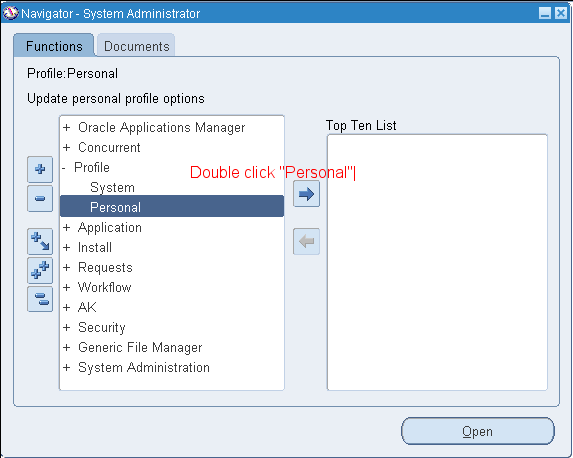
PERSONAL PROFILE:

Responsibility SYSTEM ADMINISTRATOR -->

To view personal profiles enter into the query mode and enter the profile name which we have already then we get profile value details.


To check the validation done against the Profile value while setting:

Responsibility APPLICATION DEVELOPER -->


Use of the API FND_PROFILE

It is used to perform various actions related to profile values through PL/SQL. Some of the important ones are listed below

1. FND_PROFILE.GET(‘Name of the Profile’, variable name);
Example
SELECT fnd_profile.value('PROFILEOPTION')
      ,fnd_profile.value('MFG_ORGANIZATION_ID')
      ,fnd_profile.value('ORG_ID')
      ,fnd_profile.value('LOGIN_ID')
      ,fnd_profile.value('USER_ID')
      ,fnd_profile.value('USERNAME')
      ,fnd_profile.value('CONCURRENT_REQUEST_ID')
      ,fnd_profile.value('GL_SET_OF_BKS_ID')
      ,fnd_profile.value('SO_ORGANIZATION_ID')
      ,fnd_profile.value('APPL_SHRT_NAME')
      ,fnd_profile.value('RESP_NAME')
      ,fnd_profile.value('RESP_ID')
  FROM DUAL;


2. variable name := FND_PROFILE.VALUE(‘Name of the profile’);
3. FND_PROFILE.PUT(‘Name of the profile’, value of the profile);

Example
SET SERVEROUTPUT ON;
DECLARE
   v_conc_login_id      NUMBER;
BEGIN
   FND_PROFILE.put ('CONC_LOGIN_ID',1425);
   fnd_profile.get ('CONC_LOGIN_ID', v_conc_login_id);
   DBMS_OUTPUT.put_line (v_conc_login_id);
END;
Output:
1425
PL/SQL procedure successfully completed

The 1st and 2nd are same but, the only difference is FND_PROFILE.GET is the procedure and FND_PROFILE.VALUE is the function so, it return a value.  

Apart from the above procedures we have another important one named FND_PROFILE .SAVE used to set the profile values from backend. A detail regarding this API is available in another article. 

Interface error tables in Oracle Apps


Following are the interface error tables used in oracle apps:

This table stores the processing messages which will be generated during Order Entry concurrent program execution or UI process. This is a multi-lingual table.

SELECT OPT.*
  FROM OE_PROCESSING_MSGS OPM, OE_PROCESSING_MSGS_TL OPT
 WHERE     OPM.TRANSACTION_ID = OPT.TRANSACTION_ID
       AND OPT.LANGUAGE = 'US'
       AND ORIGINAL_SYS_DOCUMENT_REF = LV_DOC_REF

PO_INTERFACE_ERRORS contains error message information generated by the open interface programs in Oracle Purchasing. For every interface transaction row with errors, this table contains a row for each column that has an error.

SELECT *
  FROM PO_INTERFACE_ERRORS
 WHERE INTERFACE_LINE_ID = LN_INT_TRX_ID -- interface transaction id


MTL_TRANSACTIONS_INTERFACE allows calling applications to post material transactions (movements, issues, receipts etc. to Oracle Inventory transaction module.

The Transaction Manager picks up the rows to process based on the LOCK_FLAG, TRANSACTION_MODE, PROCESS_FLAG. Only records with TRANSACTION_MODE of '3', LOCK_FLAG of '2', and PROCESS_FLAG of '1' will be picked up by the Transaction Manager and assigned to a Transaction Worker. If a record fails to process completely, then PROCESS_FLAG will be set to '3' and ERROR_CODE and ERROR_EXPLANATION will be populated with the cause for the error.

SELECT ERROR_CODE,
            ERROR_EXPLANATION
  FROM MTL_TRANSACTIONS_INTERFACE
 WHERE TRANSACTION_REFERENCE = LN_TRX_REF


Interface data that failed in AutoInvoice validation are populated with the error details

SELECT *
  FROM RA_INTERFACE_ERRORS_ALL
 WHERE INTERFACE_LINE_ID = LN_INTF_ID


The HZ_PARTY_INTERFACE_ERRORS table contains the error messages that are generated while mapping data from the HZ_PARTY_INTERFACE table into other HZ tables.

SELECT *
  FROM HZ_PARTY_INTERFACE_ERRORS
 WHERE PARTY_INTERFACE_ID = LN_PARTY_INTEFACE_ID


MTL_INTERFACE_ERRORS stores errors that occur during the item interface process reporting where the errors occurred along with the error messages.

SELECT *
  FROM MTL_INTERFACE_ERRORS
 WHERE TRANSACTION_ID = LN_TRX_ID --Row identifier for row in MTL_SYSTEM_ITEMS_INTERFACE

  
WIP_INTERFACE_ERRORS stores the text of errors or warnings issued when loading information through the WIP Scheduling and Open Job and Schedule interfaces. It also stores information about the load requests that generate the errors. When the WIP Mass Load program loads records from the WIP Scheduling Interface, you can print a report showing these errors.

SELECT *
  FROM WIP_INTERFACE_ERRORS
 WHERE INTERFACE_ID = LN_INTF_ID


AP_INTERFACE_REJECTIONS stores information about invoice data from the AP_INVOICES_INTERFACE and AP_INVOICE_LINES_INTERFACE tables which could not be processed by Payables Open Interface Import.

SELECT * FROM AP_INTERFACE_REJECTIONS

Oracle Fusion - Cost Lines and Expenditure Item link in Projects

SELECT   ccd.transaction_id,ex.expenditure_item_id,cacat.serial_number FROM fusion.CST_INV_TRANSACTIONS cit,   fusion.cst_cost_distribution_...